Head Office
No. 8 Klunye Adjele Street
East Legon, Accra – Ghana

No. 8 Klunye Adjele Street
East Legon, Accra – Ghana
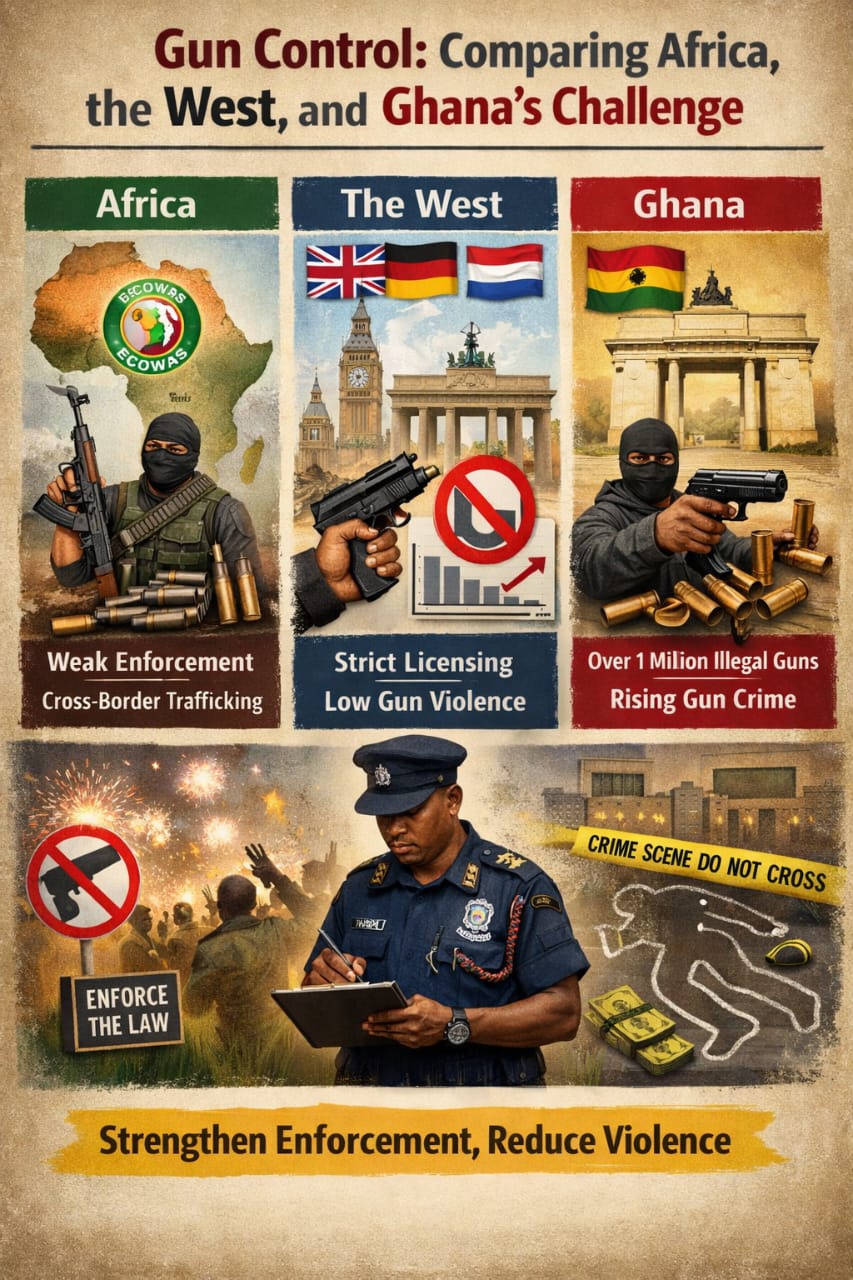
Gun control is not just about passing laws; it is about enforcing them. A global study between Africa, Western Europe, and the United States highlights a consistent pattern: countries that pair stringent firearm regulations with credible enforcement experience lower rates of gun violence. Ghana has to pay attention.
Across Africa, gun laws vary in severity and application. For instance, South Africa operates under a strict Firearms Control Act which requires licensing, background checks, and competency certification. Regionally, the Economic Community of West African States (ECOWAS) has ratified a convention to restrict small arms trafficking and regulate civilian possession.
However, these frameworks are undermined across the continent by porous borders, weak monitoring systems, and inconsistent enforcement. The challenge is often not the absence of regulation, but the failure to enforce it consistently.
Countries in Western Europe demonstrate a different outcome. The United Kingdom, Germany, and Netherlands enforce stringent firearm licensing systems that include background checks, mandatory training, and strict restrictions on weapon classifications.
Consequently, firearm ownership is treated as a regulated privilege and not an inherent right. As a result, these countries maintain some of the lowest firearm homicide rates in the developed world.
Contrarily, the United States, with broader constitutional protections for gun ownership, experiences significantly higher levels of gun violence compared to its European counterparts. The contrast highlights a critical lesson: broader access combined with fragmented enforcement tends to increase risk.
Ghana legally requires firearm licenses and bans celebratory gunfire. However, enforcement gaps remain a major concern. According to reports, there may be over a million unregistered firearms circulating nationwide; armed robbery, land disputes, chieftaincy conflicts, and other violent crimes increasingly involve illegal weapons.
The challenge is obvious: there are existing laws, however, enforcement is inconsistent. lax border restrictions, limited firearm tracking systems, and slow prosecution processes allow illegal arms to circulate with relative ease.

If Ghana is determined about reducing gun violence, there must be policy reform on enforcement capacity. This reforms should include but not limited to the following:
Global data is clear, stringent regulation only effective when enforcement is credible and consistent.
Gun control in Ghana is not merely a legal issue; it is a governance test. The state must move beyond legislation and demonstrate the institutional discipline required to protect citizens.
